A Practical Guide: Off-Grid vs Hybrid vs Grid-Tied for C&I
How commercial and industrial sites should think about energy independence, resilience, and long-term cost.
Modern C&I operations—manufacturing, logistics, retail centres, cold storage, mining—depend on one thing above all else:
Stable, predictable power.
But between tariff increases, power outages, diesel volatility and rising sustainability targets, many businesses are asking a simple question:
Should we stay grid-connected, go hybrid, or move fully off-grid?
The truth is: each option works — but only when matched to the right operational profile.
This guide breaks down the practical differences, costs, technical requirements and risks, so decision-makers can choose based on engineering and financial logic, not guesswork.
The Three C&I Energy Models, Explained Simply
1. Grid-Tied (Solar Only)
How it works: Solar feeds your daytime loads and reduces your day time electricity bill. The grid supplies the rest.
Best for: Retail centres, commercial buildings, business parks, light industrial.
|
Strengths: |
Limitations: |
|
· Lowest capex |
· Zero backup during outages |
|
· Strong daytime cost savings |
· No protection for critical loads |
|
· Quickest to deploy |
· No evening storage benefits |
|
· Minimal system complexity |
Grid-tied is ideal when uptime risk is low and daytime savings are the priority.
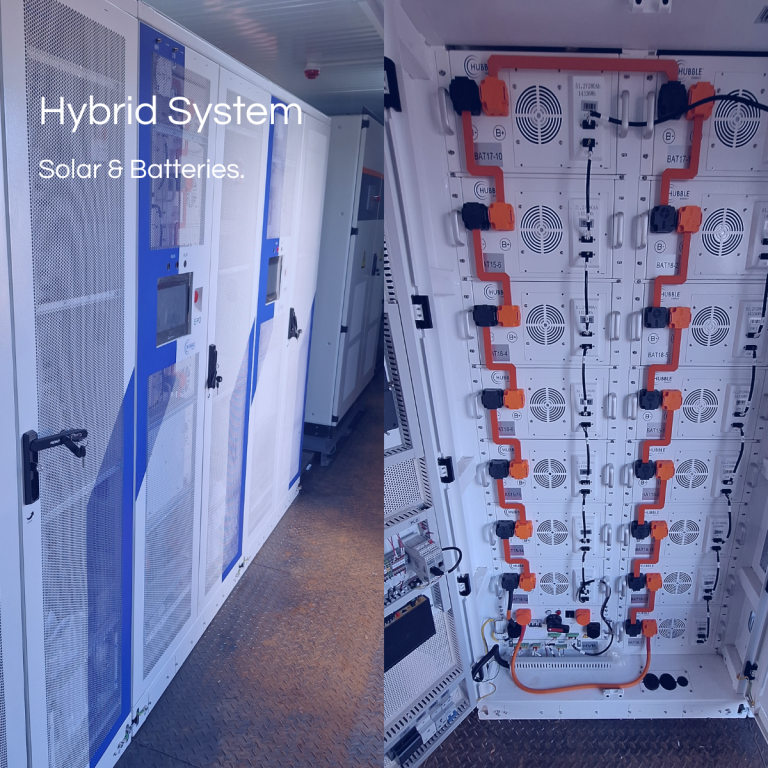
2. Hybrid (Solar + Battery + Grid)
How it works: Solar handles daytime loads → excess charges the battery → battery runs critical loads during outages or during peak demand times → grid remains the safety net.
Best for: Manufacturing plants, logistics hubs, cold storage, data-dense operations, heavy C&I.
|
Strengths: |
Limitations: |
|
· Power outage protection |
· Higher capex than grid-tied |
|
· Reduced diesel reliance |
· Requires proper O&M to sustain performance |
|
· Lower peak demand charges (NMD management) |
|
|
· Better power quality for sensitive equipment |
|
|
· Predictable operating costs |
|
|
· Scalable over time |
Hybrid is the most common C&I choice because it provides resilience without the cost burden of full autonomy.
3. Off-Grid (Full Island Model)
How it works: The site operates independently with solar + battery + backup generation. No reliance on the grid.
Best for: Remote mines, remote agri-processing, remote commercial operations, game lodges, isolated C&I where grid extension is impractical.
|
Strengths: |
Limitations: |
|
· Total autonomy |
· Highest capex |
|
· No grid failures |
· Requires large storage and backup systems |
|
· Fully controllable energy ecosystem |
· More engineering + operational oversight |
|
· Zero tolerance for design or maintenance errors |
Full off-grid works extremely well — but only when a site genuinely needs it.
The Key C&I Factors That Decide the Right System
Choosing between grid-tied, hybrid and off-grid comes down to a handful of practical variables:
1. Load Profile
- Flat loads (cold storage, 24/7 plants): Hybrid or off-grid
- Daytime-heavy loads (retail, commercial offices): Grid-tied
- High-demand motors (pumps, compressors): Hybrid with peak shaving
2. Reliability Requirement
Ask – Can the site tolerate outages at all?
- If no downtime allowed → Hybrid or off-grid
- If occasional downtime is manageable → Grid-tied
3. Tariff Structure & NMD Charges
For many C&I sites, tariff design determines the ROI more than solar sizing.
Hybrid systems can:
- Reduce NMD changes
- Avoid high peak-time tariffs
- Shift load using batteries
- Monetise excess via wheeling (site dependent)
Grid-tied cannot.
4. Diesel Spend
If diesel is a major expense, hybrid almost always pays for itself faster.
Off-grid can eliminate diesel entirely if you opt to go with no back-up for your battery — but with greater capex.
5. Capex vs Opex Preferences
- Grid-tied: lowest capex, can be funded (PPA)
- Hybrid: balanced, can be funded (PPA/rental)
- Off-grid: highest capex, highest engineering requirement
6. Expansion Plans & Future Proofing
- Hybrid systems scale easily
- Grid-tied can be expanded but offers no backup
- Off-grid expansions require careful re-modelling to avoid instability
Always remember that it is a journey to electrical independence and you don’t have to do it all at once. You could initiate your savings with a grid-tied solution and then use those savings to fund a hybrid solution in the future. We can map it out with you.
The C&I System Comparison Table
Feature |
Grid-Tied |
Hybrid |
Off-Grid |
|
Backup Power |
❌ None |
✅ Critical loads |
✅ Full site |
|
Capex |
Low |
Medium |
High |
|
Diesel Reduction |
None |
Significant |
Full elimination |
|
Peak Shaving (NMD) |
❌ |
✅ |
N/A |
|
Tariff Optimisation |
Limited |
Strong |
None |
|
Suitable For (not exclusive lists) |
Retail, offices, business parks |
Manufacturing, logistics, cold storage |
Remote or grid-unstable operations |
|
Complexity |
Low |
Moderate |
High |
|
Risk if Undersized |
Low |
Medium |
High |
|
Scalability |
Good |
Very good |
Complex but possible |
How C&I Sites Should Decide: A Practical Framework
Choosing between grid-tied, hybrid and off-grid becomes much easier when you answer three practical questions.
Answer these three questions:
1. What happens to your operation during an outage?
A. “It’s inconvenient, but we can work around it.”
→ You’re likely a Grid-Tied site.
Solar reduces daytime costs, and outages don’t materially damage operations.
B. “Some processes cannot go down — cold rooms, IT, key lines.”
→ You’re in Hybrid territory.
Batteries carry your critical loads; the grid handles the rest.
C. “If power drops, the whole plant stops.”
→ Move to Question 2 — you may need Hybrid with larger storage or Off-Grid.
2. How strong and reliable is the grid at your location?
A. Mostly stable with occasional outages
→ Hybrid is usually the best fit.
It provides resilience without the cost of full autonomy.
B. Frequent outages, voltage dips or weak supply
→ Consider Hybrid with increased storage or a Microgrid configuration.
C. No grid, or grid extension is impractical
→ Off-Grid becomes the sensible option.
3. What is your priority: lowest cost or maximum control?
A. Lowest capex, focus on savings
→ Grid-Tied
B. Balance of cost, resilience and operational stability
→ Hybrid
C. Full energy independence and complete control
→ Off-Grid
So Which One Should C&I Sites Choose?
⭐ Grid-Tied
For businesses that want daytime cost reduction with the lowest capital investment.
⭐ Hybrid
For sites where uptime, diesel reduction, power quality and predictability matter.
(This is the choice most C&I sites in the current market are considering and turning to but the returns have to make sense so your site will require some analysis)
⭐ Off-Grid
For remote sites or operations where any downtime is unacceptable and the grid cannot be relied on.
Final Word for Decision-Makers
Energy strategy in the C&I space shouldn’t be driven by emotion — it should be driven by:
- Your load profile
- Tariff
- Diesel use
- Operational constraints
- Future expansion
A good system does three things:
- Keeps your business running
- Reduces long-term energy costs
- Scales as your operation evolves
If you want a clear model of which system fits your site, we can build one based on real operating data — not assumptions.
That’s how engineering-led energy decisions should be made.