City Power Tariff Changes 2025/26 – what large business users need to know.
The approved City Power tariffs become effective from 1 July 2025, which will reflect on customers’ electricity bills in August.
- What’s changed?
- Fixed charges (service and capacity) – 18.3% – and demand charges (kVA) – 17.9% – have increased at a higher rate than variable charges (kWh) – 10.3%-.
- It is clear that the City of Joburg is trying to mitigate the loss of revenue due to a decline in energy sales caused by loadshedding and the proliferation of rooftop solar systems
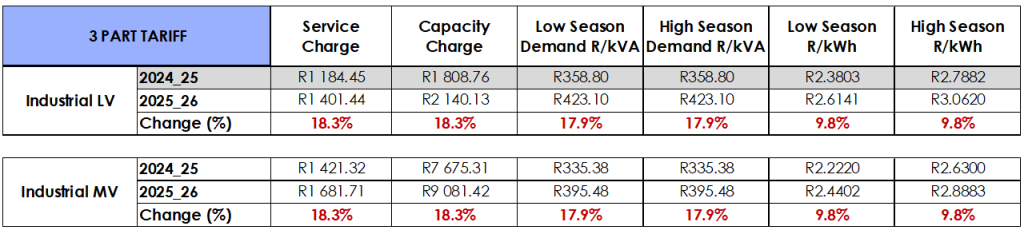
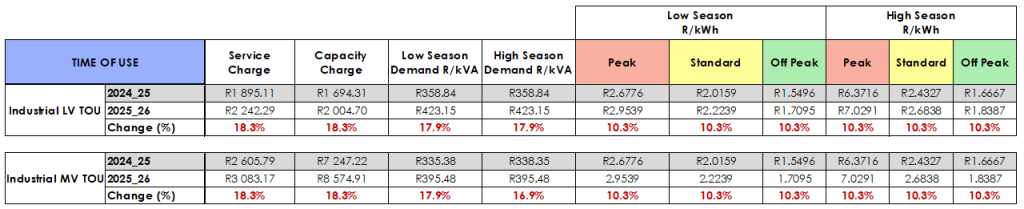
2. What this means for customers
- Higher fixed electricity overheads
- Punitive demand (kVA) charges mean customers will need to manage their loads carefully to avoid spikes in demand that can result in higher bills for many months ahead. Remember, demand is billed on the higher of the actual reading that month, or 80% of the three highest readings in the past 12 months.
- For users with smaller bills, the higher fixed cost increases could result in an overall increase in excess of 16% of their monthly bill.
3. Strategies to Consider
- Solar PV + Battery Storage: solar PV alone generates handsome returns with kWh savings. But to manage the kVA demand spikes, battery storage will need to be added to keep the spikes below programmed thresholds during times when the solar output is variable.
- Energy efficiency: it is estimated that businesses waste15-30% of electricity due to factors such as over-sized motors, inefficient lighting, poor power factor, poor insulation and idle equipment.
For assistance with solutions for your business, contact Nesa Power at info@nesapower.com